How to Hang Art Without Nails (7 Tested Methods)
You can hang art without nails using adhesive picture-hanging strips, heavy-duty adhesive hooks, museum putty, a tension rod, or an over-the-door hook — the right one depends on the weight of the piece and the wall you’re working with. A framed print under 4 pounds holds fine on standard Command strips; a mirror or canvas up to 20 pounds needs X-Large strips or a tension rod wedged between two walls. I tested all seven methods on painted drywall and a textured rental wall to see which ones actually hold and which ones peel paint on removal. Here’s what worked, with the real weight limit for each.
Why Skip Nails in a Rental
Most leases treat nail holes as damage, not normal wear, and charge a per-hole fee at move-out — often [VERIFICAR: $25–$150] depending on the property. Plaster walls in older buildings crack around a nail hole instead of leaving a clean puncture, which turns a $0 fix into a patch job. None of that means you have to hang art badly. Every method below holds real weight, and four of the seven can support a 16×20 frame without a single tool. The trade-off is planning: adhesive methods need a clean, cured, smooth surface, and they all have a hard weight ceiling you shouldn’t push past. This is the first guide in our No-Damage Wall Decor collection, where every piece is tested against real security-deposit stakes.
Method 1: Command Picture Hanging Strips
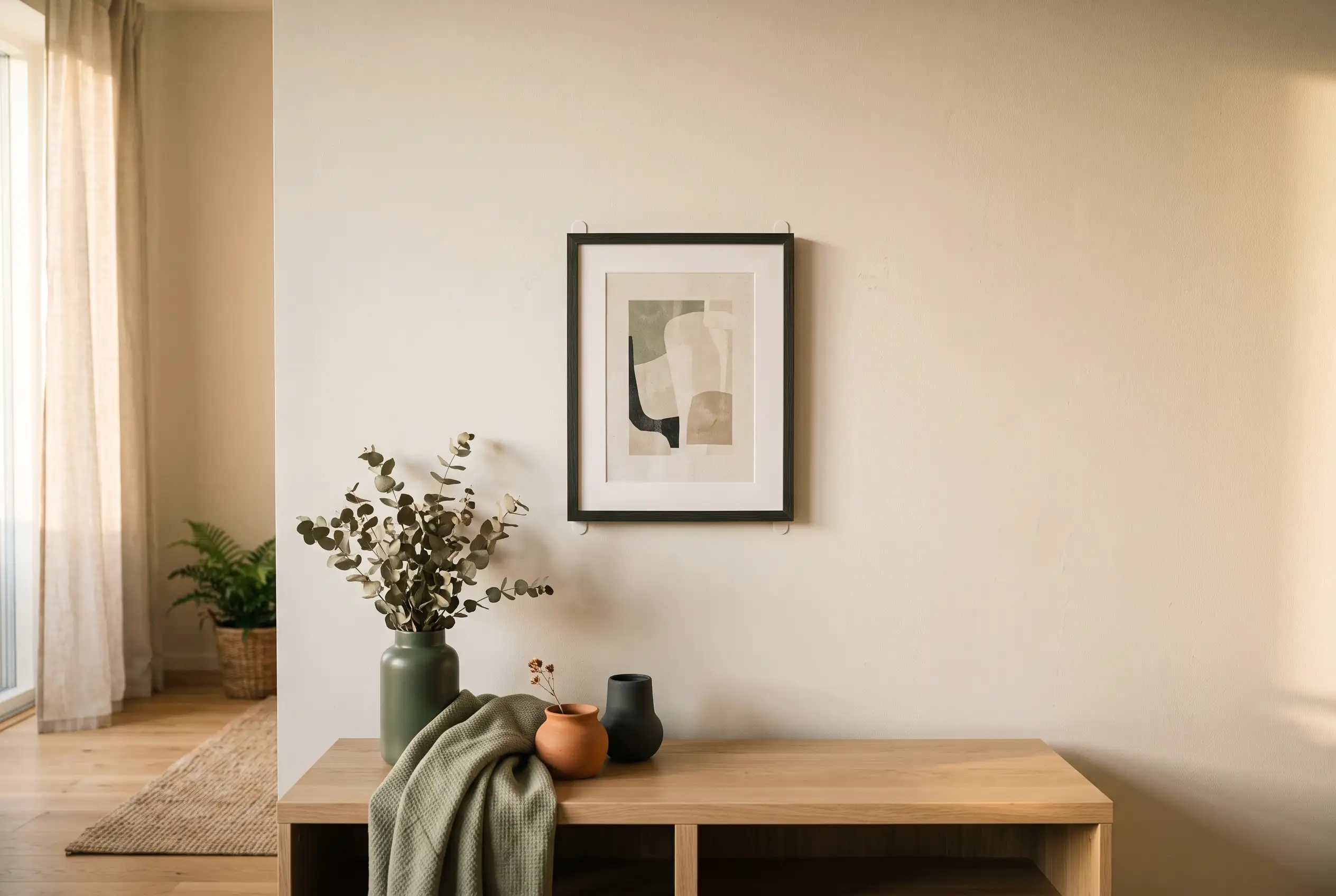
This is the default for a reason. Command Picture Hanging Strips come in three sizes: Small holds 1 pound per pair, Medium holds 3 pounds per pair, and Large holds 4 pounds per pair. For anything heavier, the X-Large Heavyweight strips hold up to 20 pounds when you use four pairs, on a frame up to 24×36 inches. Clean the wall with rubbing alcohol first — dust and oil are the actual cause of most strip failures, not the adhesive itself. Press each strip for 30 seconds, then wait one hour before hanging the frame so the bond can set. A 4-pack of Large strips runs around $6 to $8. For exact ratings by product, lists every size.
Method 2: Adhesive Utility Hooks for Heavier Pieces
For anything with a wire or a solid top edge — a mirror, a woven wall hanging, a heavier canvas — a single adhesive utility hook beats strips. The 10-pound X-Large Command hook and the 15-pound version both mount with the same rubbing-alcohol prep and 24-hour cure time before you hang anything on them. Skip the cure and the bond hasn’t reached full strength, which is the single most common reason these hooks fail early. A two-pack with strips included runs around $7 to $10. Don’t use these outdoors or in a bathroom with a shower running — humidity and temperature swings both shorten the hold.
Method 3: Museum Putty (Stabilizer, Not a Hanger)
Museum putty isn’t actually a hanging method on its own — it’s a stabilizer. A pea-sized dab under each bottom corner of an already-hung frame stops it from tilting or sliding after a bump. It also works to stick genuinely lightweight, flat items — a postcard, a small tile, a light ornament under — directly to a wall. It won’t hold a full frame by itself and softens on a hot, sun-facing wall. Roll a piece into a small ball, press it under each corner, and twist to remove later. A tub runs about $5 to $7 and covers a whole apartment’s worth of frames.
Method 4: Tension Rods for Nooks and Gallery Walls
A tension rod wedged between two walls — inside a hallway nook, a window alcove, or a narrow gap between shelves — turns into a hanging bar with zero wall contact. Clip frames to it with curtain rings or S-hooks. A standard spring tension rod holds around 20 pounds; steel, heavy-duty versions with a center support brace hold 30 pounds or more. Extend the rod to no more than 90% of its maximum length — grip strength drops fast near full extension, which is the main reason these rods slip. A basic steel rod costs $10 to $20.
Method 5: Over-the-Door Hooks
An over-the-door hook needs no adhesive and no cure time — it just hangs over the top of the door and grips with its own weight. Basic metal versions hold around ; reinforced steel versions go up to 50 pounds. This is the fastest option for a mirror or a lightweight frame in a bedroom, and it comes off in one motion when you move out. The trade-off: it only works on doors, and a hook rated for coats and towels isn’t automatically rated for a frame with a glass front, so check the weight listed on the specific hook before you hang anything fragile.
Method 6: Washi Tape for Lightweight Prints
For paper prints, postcards, or posters under, washi tape mounted directly to the wall skips hardware entirely. It’s low-tack by design, so it pulls off painted drywall without lifting paint — test an inconspicuous corner first if the wall was painted less than seven days ago. This is the cheapest method on this list at $3 to $6 a roll, and it doubles as a frame border if you tape in a rectangle around the print instead of just the corners. It will not hold anything with real weight, including a mounted print in a frame.
Method 7: Leaning Displays (Zero Wall Contact)
The only method with no weight limit at all: lean the piece against the wall on a floor, a floating ledge, a dresser top, or a mantel instead of hanging it. This works for any size or weight the surface underneath can support, and it repositions in seconds. The trade-off is floor or shelf space, and a leaned piece needs a slightly deeper base than a hung one to stay stable — anchor larger pieces with a small dab of museum putty at the bottom back edge so they can’t slide forward.
What Not to Do When Hanging Art Without Nails
Don’t apply adhesive strips or hooks to wallpaper, brick, unfinished drywall, or a wall painted less than seven days ago — the bond needs a fully cured, smooth, painted surface to hold its rated weight. Don’t guess at a frame’s weight; a bathroom scale under the frame gives you an exact number in seconds. Don’t extend a tension rod past 90% of its range to make it fit a slightly-too-wide gap — that’s the single biggest cause of a rod dropping mid-use. And don’t remove adhesive strips by pulling straight out from the wall; stretch the tab down and out, parallel to the wall, or you risk pulling paint off with it.
Frequently Asked Questions
X-Large Heavyweight Command strips, used four pairs at a time, are rated for 20 pounds and are the strongest adhesive option for a standard drywall rental. For anything heavier, a wall-mounted French cleat technically still counts as hardware, so it falls outside “no nails” — a tension rod is the next-strongest zero-hardware option at up to 30 pounds.
Not when the wall is painted, clean, and cured for at least seven days, and you remove the strips by stretching the tab down rather than pulling outward. Strips applied to unpainted drywall, wallpaper, or fresh paint are the main cause of paint pulling off on removal.
It depends on size: Small strips hold 1 pound per pair, Medium hold 3 pounds per pair, Large hold 4 pounds per pair, and X-Large Heavyweight strips hold 20 pounds using four pairs. Always check the specific package, since ratings vary by product line.
Adhesive strips and hooks need a smooth surface to bond, so textured plaster and exposed brick are poor candidates. A tension rod wedged between two walls, an over-the-door hook, or a leaning display all avoid the adhesion problem entirely since none of them stick to the wall surface itself.